
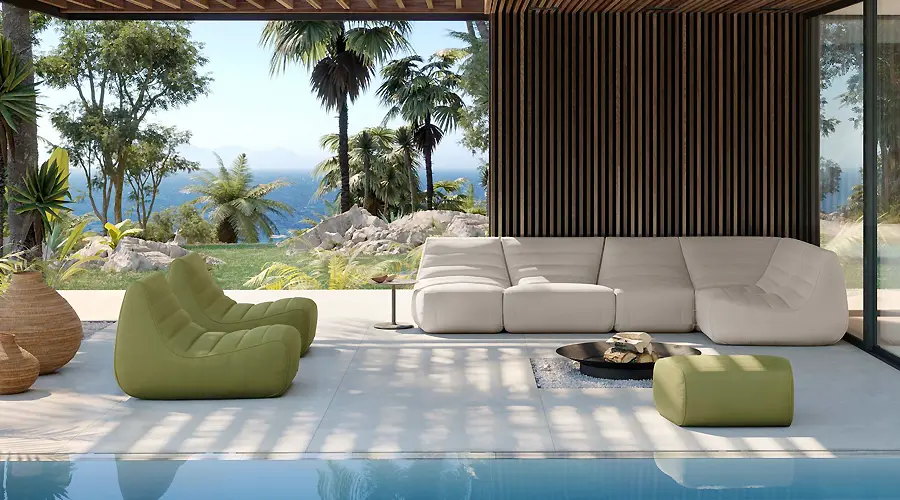
Original Ligne Roset | Product accompanied by certificate of authenticity
Togo, Ploum, Pumpkin: Sofas Redefining Contemporary Comfort
The Ligne Roset catalogue reads as a sequence of revolutions in the way the sofa is conceived. The Togo, designed by Michel Ducaroy in 1973 and produced continuously to this day with over 1.2 million units sold, is the point of departure: no feet, no visible rigid structure — only expanded polyurethane and continuous pleating that make the body of the user the sole load-bearing axis. Fifty years after its debut, Togo is still in production without substantial modification — the mark of an absolute design achievement. The Ploum, signed by brothers Ronan & Erwan Bouroullec, carries the same philosophy of radical comfort into an organic, soft form inspired by the natural landscape. The Pumpkin by Pierre Paulin — a pivotal figure in French design of the 1960s and 1970s — is a living historical document: an armchair that still feels ahead of the moment in which it was designed. Alongside these stands the Prado by Christian Werner, completing an upholstered catalogue that chronicles fifty years of experimentation on comfort.
The Savoir-Faire of Briord and a Catalogue That Is an Entire Art de Vivre
The main atelier in Briord, in the heart of the Ain, is where the majority of Ligne Roset's work is still carried out by hand: five plants across Ain, Rhône, and Isère — all in France — guarantee a production chain that has never been relocated. This direct control over the manufacturing process translates into a level of personalisation that few brands in the world can offer: every sofa is configurable in hundreds of fabrics and leathers, and every fabric is developed in-house with exclusive colourways. The Ligne Roset catalogue is not a list of products: it is an art de vivre that encompasses sofas, seating, tables, bookshelves and storage, lighting systems, rugs, textiles, bedlinen, and decorative objects.
Bring Ligne Roset into Your Project
Our team will guide you in selecting the Ligne Roset sofa, armchair, table, bookshelf, lamp, or rug best suited to your space. We reserve an exclusive price and a dedicated consultation for architects, interior designers, and private clients.
The Collections: High-End Living, Dining and Total Home Design
The Ligne Roset catalogue covers every dimension of contemporary living with fully Made in France production, customisable configurations, and collaborations with world-renowned designers:
- Sofas and armchairs: the icons Togo (Michel Ducaroy, 1973), Ploum (Ronan & Erwan Bouroullec), Pumpkin (Pierre Paulin), Prado (Christian Werner), and dozens of other collections; available in hundreds of fabric, leather, and alcantara configurations; structures handcrafted in the Briord atelier
- Dining tables and coffee tables: tables in wood, metal, and glass in organic or geometric forms; stackable and modular coffee tables; caffè tables as autonomous sculptural pieces
- Bookshelves and storage units: open systems, sideboards, buffets, and storage pieces that bring the same formal care of the upholstered range into the living space; lacquered, veneered, and natural wood finishes
- Lighting: pendant, floor, and table lamps created in collaboration with designers of the calibre of Ionna Vautrin and other members of the Ligne Roset roster; an integral part of the catalogue, not merely accessories
- Rugs and textiles: hand-knotted and hand-woven rugs, exclusive in-house developed fabrics, bedlinen and cushions in first-quality fibres
- Accessories and decorative objects: vases, mirrors, decorative objects, and accessories signed by the same designers behind the main collections — pieces that carry the Ligne Roset language into every last detail of the home
FAQ – Ligne Roset: Your Questions, Our Answers
Who founded Ligne Roset and when was the brand established?
The company was founded in 1860 in Oussiat (Ain, France) by Antoine Roset, who set up a small factory producing wooden ribs for umbrellas. Towards the end of the nineteenth century he converted production to chairs, and his grandson Jean Roset created the first contract collections in the 1950s. The Ligne Roset brand was officially established in 1973, the same year the Togo sofa by Michel Ducaroy was presented and the first mono-brand store was opened. Today the company remains family-run, led by Pierre and Michel Roset, the fourth and fifth generations.
What is the Togo sofa and why is it so famous?
The Togo is Ligne Roset's most iconic sofa, designed by Michel Ducaroy in 1973 and produced continuously to this day. The secret of its success is radical: no feet, no rigid structure, no conventional form — only expanded polyurethane at varying densities and continuous pleating that make the body of whoever sits in it the sole support. With over 1.2 million units sold across more than fifty years of production, Togo is the best-selling sofa in Ligne Roset's history. Its form has remained unchanged — it never needed updating because it was already ahead of its time.
Where is Ligne Roset furniture produced?
Ligne Roset is the world's only publisher-manufacturer-distributor of high-end Made in France furniture. All production takes place across five plants located in Ain, Rhône, and Isère — all in France — and the majority of the work is still carried out by hand. This direct control over the entire production chain is the foundation of the quality and level of personalisation that Ligne Roset guarantees.
Furniture and Home Design Brands